Distributor excess inventory
Explore overstock lots outside normal distribution channels.
Find a business to explore, or start with a market you already understand.
Find and run a business ↗Beta · AI can make mistakes · Register for more fine-grained controls
Explore these examples while the finder loads.
Explore overstock lots outside normal distribution channels.
Explore a market with model-specific comparisons and a collector base.
Explore short-term storage needs outside standard contracts.
Business Builder is the HyperC app that runs in a workspace of your own. Pick a market from the Market Store, describe your own idea, or bring your own AI agent: robots find the market’s data sources, collect the data and assemble menus of deals. P34 chooses what to buy and how much, and every portfolio waits for your review.
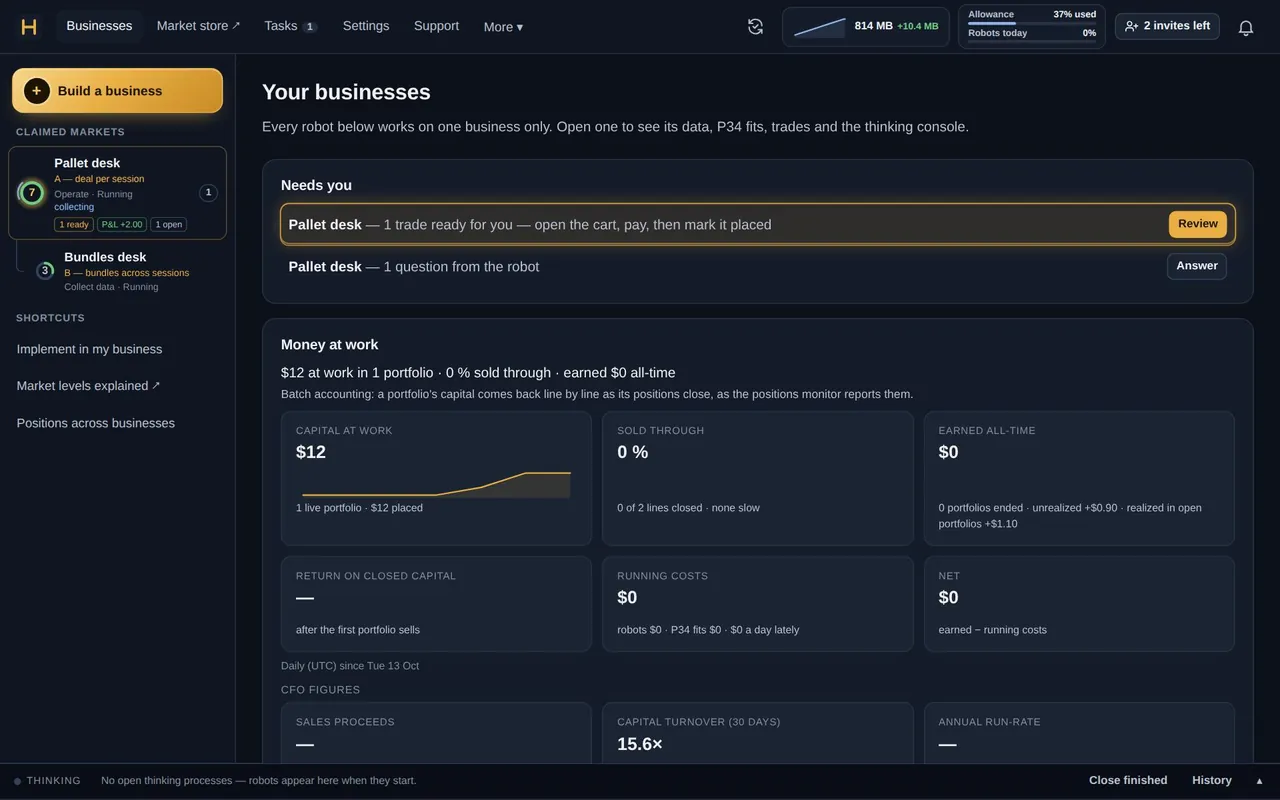
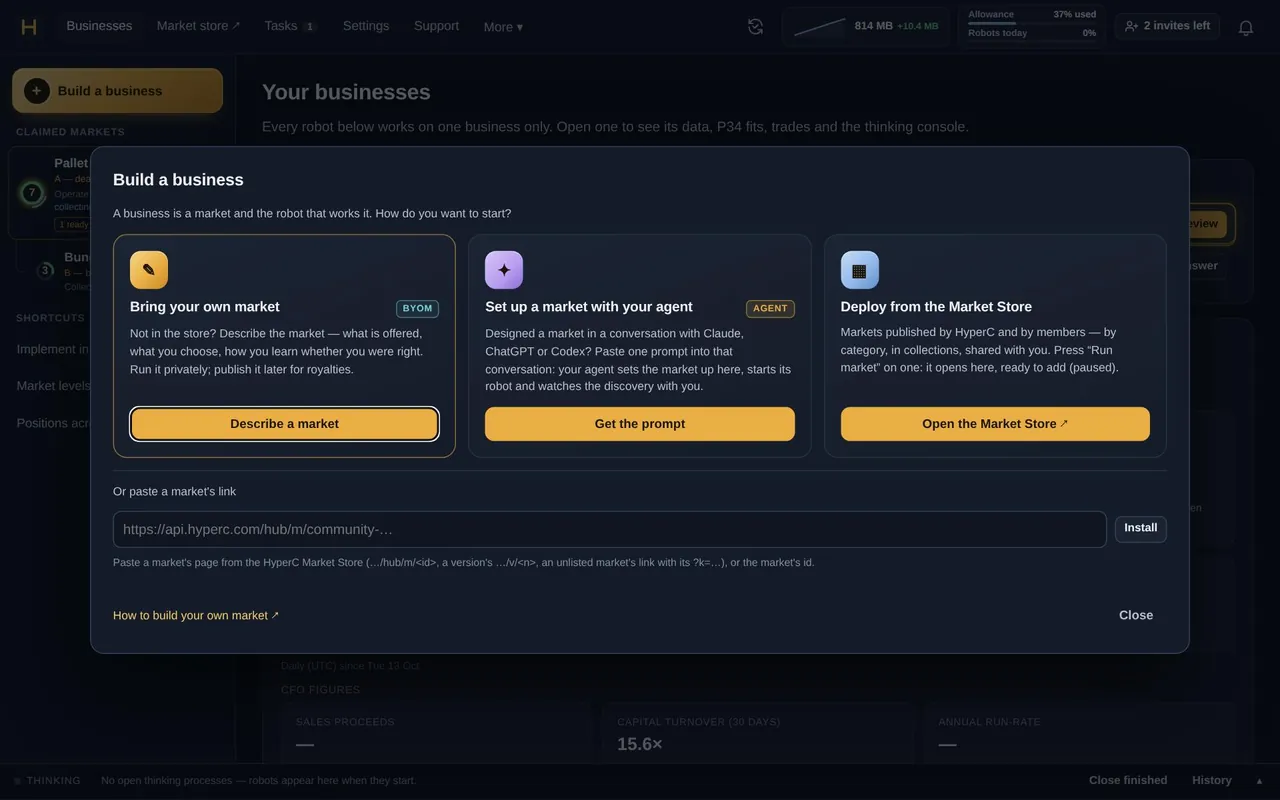
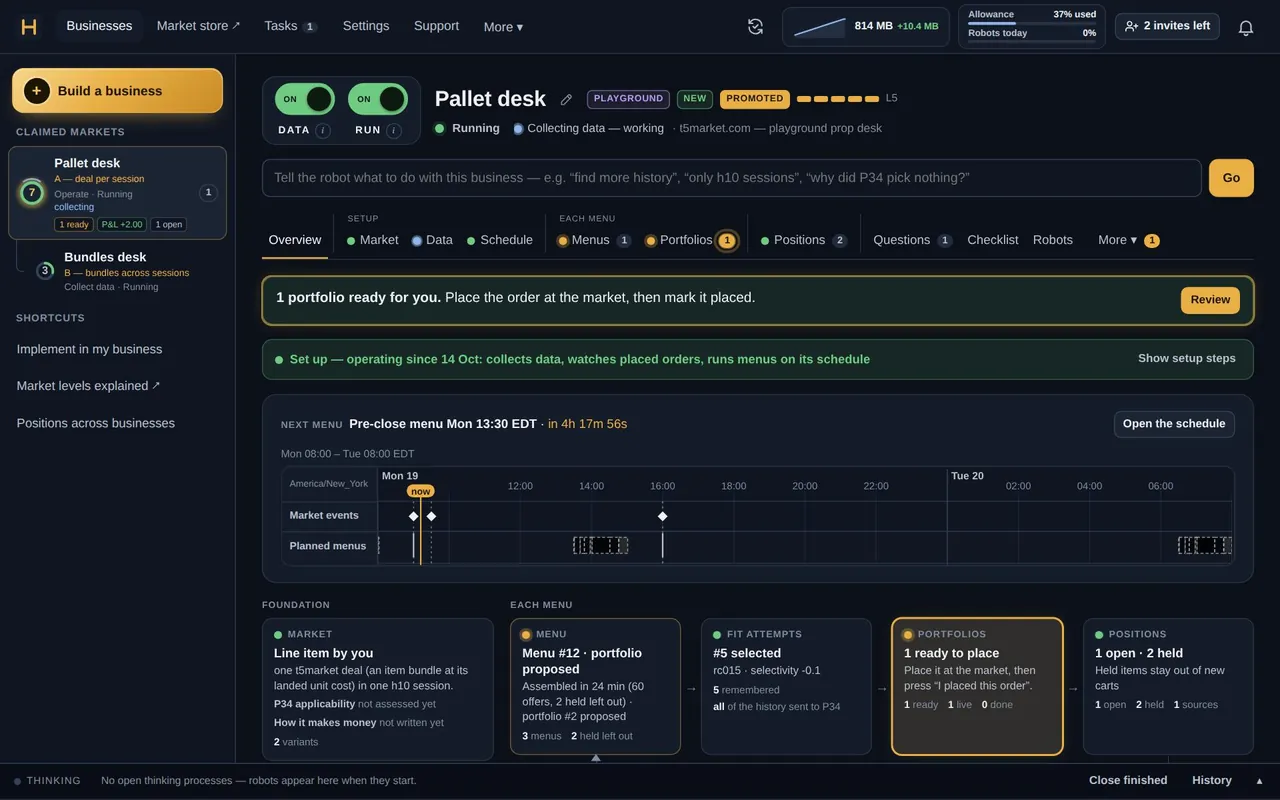
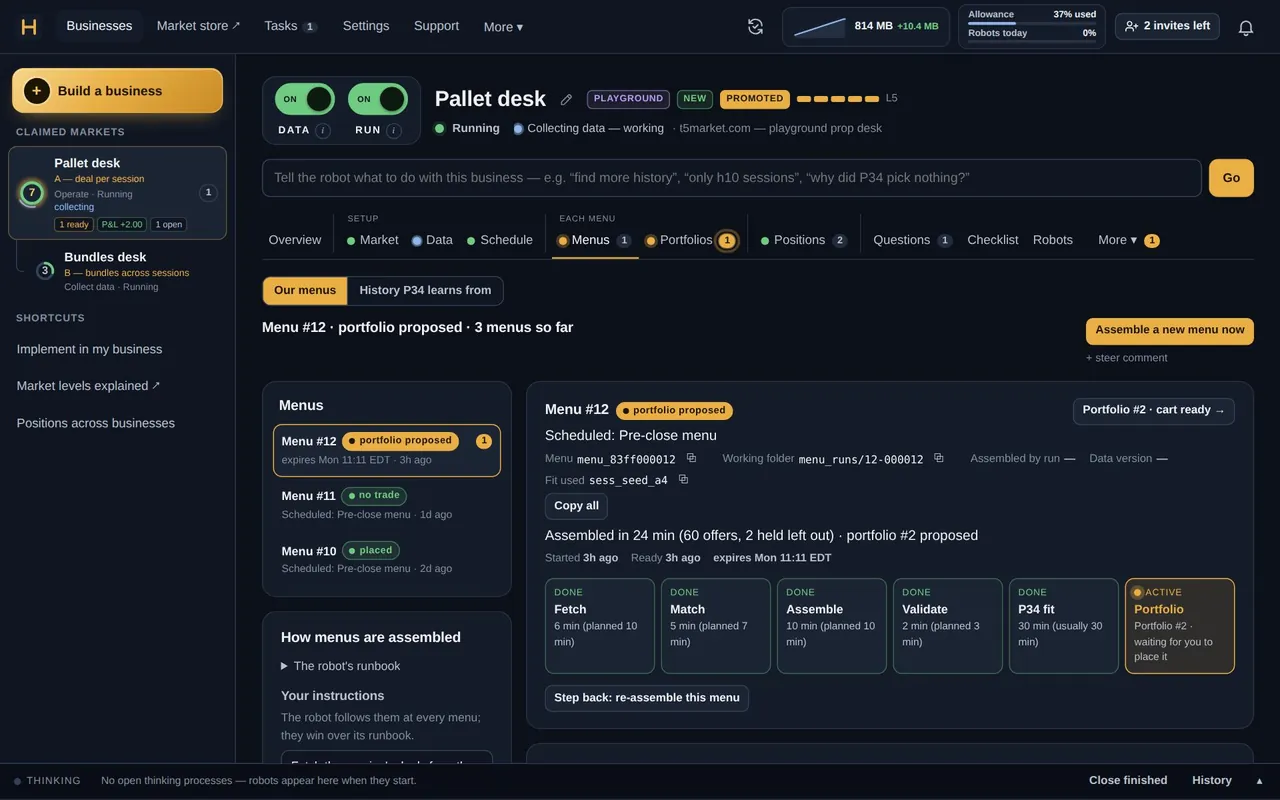
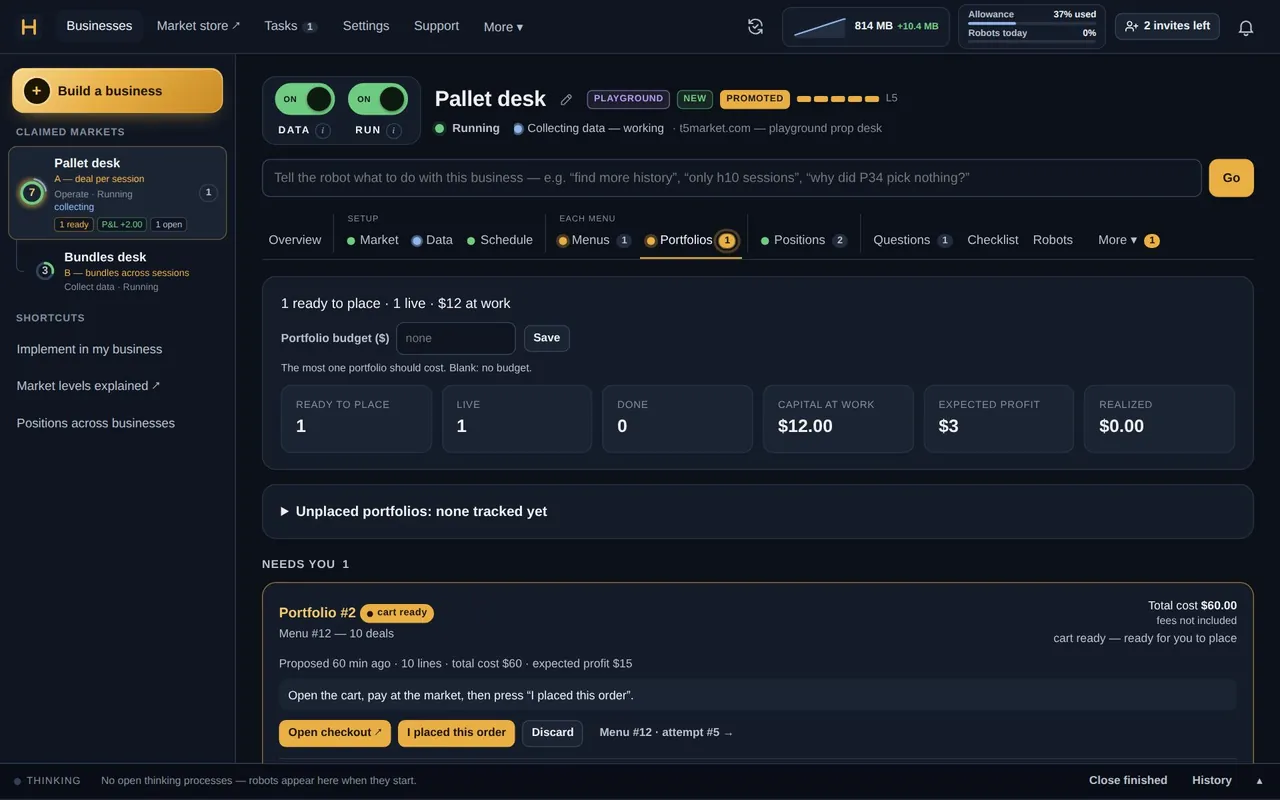
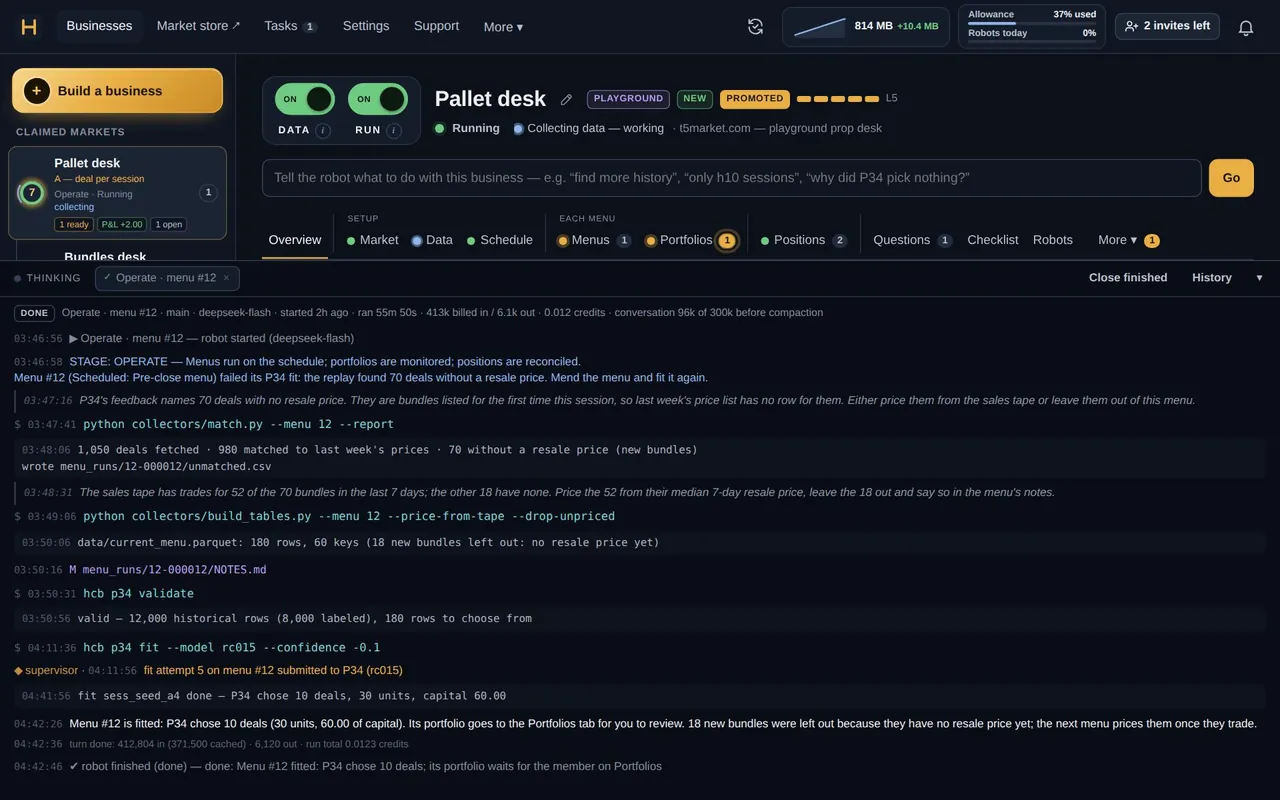
Screens from Business Builder with demo data. Beta — no profit is promised. Business Builder comes with a paid plan; free registration covers the Market Store.
HyperC takes on some of the hardest problems in economic decision-making: incomplete information, biased histories and allocating limited capital in changing markets. We combine economic theory, market simulations and pretrained models with the tools to test them in real business workflows.
Our research into generalized arbitrage asks where differences in value survive costs and risk, and which opportunities a particular business can actually capture. P34, the API and Business Builder put that research to work.
Register free to explore and collect markets, with $1 in starter credits. Describe an idea and publish a market card for sale — a suggested starting price is $0.01. Free Marketplace access does not include Business Builder. Running a business requires a paid Builder subscription, which adds credits every week; unused paid-plan credits accumulate.
Explore ideas and start collecting markets. Open to everyone, with no subscription.
Business Builder in a bigger workspace of your own — room for a market or two.
Monthly product/service subscription. Not equity, a pooled investment or guaranteed earnings.
Your managed AI business workspace, with the founding grant of weekly plan credits: 50 100 tokens every week — 400 tokens a month. Paid-plan credits are added every Monday and unused credits accumulate; when a week runs out, pay-as-you-go tokens keep you going. Compute tokens are globally in short supply, and we are not an exception.
Monthly product/service subscription. Not equity, a pooled investment or guaranteed earnings.
The P34 model without the workspace: call it from your own code or agent and pay only for the compute each calculation uses. 1 token = $1, and tokens you buy never expire.
POST /validate and mock fitsPrepaid usage, no subscription. Not equity, a pooled investment or guaranteed earnings.
No. The platform helps with research, comparisons and monitoring. You still review decisions, supply capital and permissions, and handle physical work such as inspecting, packing or shipping where the business needs it. See the worked example for how costs and unsold inventory can change the result.
Finder suggestions are ideas to investigate, not verified integrations, customer case studies or earnings forecasts. The business examples explain possible workflows and the human work they require. Published case studies live on the industry cases page, with customer permission and metric definitions.
We do not know, and anyone who tells you a number for your market has not looked at it. P34 is built to pursue profit by scoring opportunities and refusing weak ones; it does not promise that any accepted action, member or period will be profitable. You supply the capital and keep the result — positive or negative.
There are billions of potential business opportunities and combinations — far too many to fully enumerate. Scout saves new discoveries as it explores the world of businesses and keeps personalized memory for each user. That memory helps it explore different branches instead of repeatedly following the same paths, while developing a more specialized understanding of your interests and markets as you scout more.
Businesses developed by early members can also become more efficient as they gather data, add features and deepen their understanding of their market. Those advantages can make direct competition harder and less attractive to new entrants, encouraging them to explore other opportunities. We expect these forces to support a natural balance, but they do not eliminate competition or guarantee profitability: any individual market can still become crowded.
Collection and preparation: crawling authorized sources, calling permitted APIs, normalizing listings, joining prices to outcomes, building the menu and calling P34 on it. In the default configuration it stops there and waits for you. Where a workflow supports automation, it runs bounded — budgets, caps, audit logs and an emergency stop — and you enable it explicitly.
Our mission is to serve the people of Earth, not one big AI. We want people to build and own businesses, with AI working for them. That is our unique proposition and what sets us apart from the supergiant AI companies. We still charge fees for the tools and services we provide — and, if we're lucky, serving all those businesses may become a big business for us too.
It helps, but it is not the gate. Your agent does most of the operating work, and market blueprints and templates cover the common paths. You do need to understand the market you operate in and to review what the system proposes.
Not by default. You review and authorize spending. Any supported automation needs your explicit approval, budgets and stop controls, and must use permitted integrations and data sources. Account permissions, custody and withdrawals remain your responsibility.
Collection tools are for authorized and public data, used in compliance with applicable law, access permissions, website terms and plan policies. Network profiles exist for lawful regional access, privacy and testing — never for bypassing paywalls, bans, authentication or platform controls. A source being reachable does not mean it is licensed for your use.
Start with a shadow test on your own data, then a capped pilot before scaling with controls. See HyperC for enterprise to discuss your market and workflow.
Monthly access to software, compute and managed services. Built to pursue business outcomes; no profit is promised. Not equity, a pooled investment or guaranteed earnings.
Not ready to subscribe? Join the free AI-economy fan community and get notified about price drops and promotions.
Follow the self-driving business movement at no cost: market experiments as we run them, member findings, P34 and agent-tool releases, research on the emerging AI economy — and first access when the P34 Community opens.
Free forever · no spam · unsubscribe anytime · Privacy Notice